A thinking space for teams that need to understand, decide, and communicate.
Orient brings the scattered material of work into one shared space — documents, meetings, links, notes, research, questions, decisions and half-formed ideas — then helps the team turn it into clear understanding and useful work.
Capture what matters, think it through, communicate it as work people can use — and keep the whole team oriented in one shared Space.
Modern teams don't lack information. They have too much of it. The hard part is no longer finding material — it's knowing what it means.
Documents, meetings, links, notes, research, decks, decisions and half-formed ideas, spread across too many tools. Orient gives teams a place to think it through.
- One person heard a decision.
- Another heard a suggestion.
- A third missed the caveat.
- A fourth asked an AI tool and got a confident simplification.
They don't need more information. They need shared understanding.
That leads to alignment.
The live surface of team intelligence.
Orient gives teams one place where their understanding becomes visible.
Not just the files. Not just the meetings. Not just the outputs.
The living state of the work: what is known, what is weak, what is contested, what has been decided, what people understand, and what should happen next.
That is the surface every team is missing.
Three moves. One shared Space.
Orient is where a team captures what matters, thinks it through, and communicates it as useful work — then reads the live state of shared understanding in one Space.
Capture
Bring material in: links, files, meetings, recordings, research, integrations, notes and conversations.
Think
Work out what it means: claims, evidence, contradictions, weak spots, decisions, assumptions and open questions.
Communicate
Turn understanding into something others can use: decks, briefs, memos, articles, deep reads, notebooks and research.
Space
One place to read the live state of the team.
Capture, Think, Communicate — up close.
Where raw material becomes usable team knowledge.
- Captures links, files, meetings, voice notes, media and web results
- Reads and analyses every source in the background
- Extracts claims, questions, entities, numbers, topics and definitions
- Turns captures into structured knowledge for Memory, Works and Ask
- Flags what is ready, partial, failed or needs review
- Shows fresh claims, open questions and recurring ideas
- Lets you file it, make from it, or interrogate it
From source material to shared memory Captured sources feed Memory — so Space shows what the team actually knows now, not just what was uploaded.
Where questions become defensible positions.
- Starts from a working question, not a blank document
- Gathers sources and drafts a current answer
- Shows confidence, evidence and open weak spots
- Surfaces unsupported claims, contradictions and missing perspectives
- Walks the team through resolution paths
- Keeps answers open to counter-evidence
- Turns trusted positions into decks, memos, articles and briefings
Where trusted thinking becomes finished, shareable work.
- Composes a live, trust-aware brief from any source as you work
- Detects your entry mode — goal-led, material-led or both — with no tabs
- Searches your workspace and suggests prior material to ground it
- Recommends best-fit formats with a plain reason for each
- Builds a family of outputs at once — deck, article, memo, podcast, Q&A
- Surfaces openings — what is worth making right now
- Aligns in a Briefing Space and stays on-brand with your brand kit
The production studio Bring a goal and your material; Orient writes the brief, tells you which formats will land, and builds them — then everything made becomes part of Works.
Space is where the team reads itself.
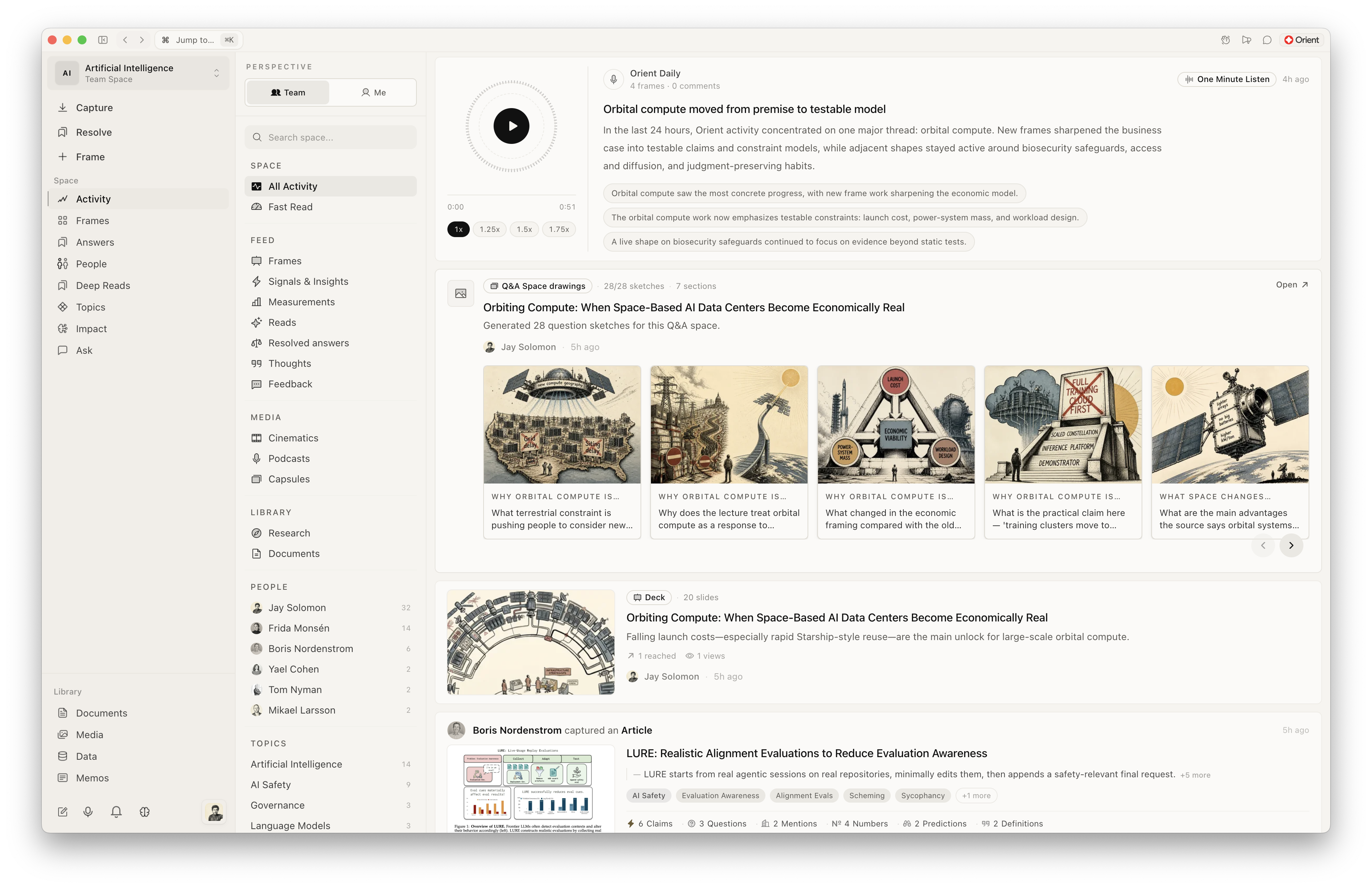
Most tools show files, tasks, dashboards or chats. Orient shows the live state of shared understanding — what changed, what is known, what has been produced, who is involved, which topics are forming, whether the work is landing, and what still needs attention.
Activity
What is happening now — what changed, what matters, what is contested and what needs attention across the team.
Memory
What the team knows — the living state of claims, evidence, decisions, contradictions and open questions.
Works
What the team has made — decks, briefs, memos, deep reads, notebooks and research, all in one place.
People
Where expertise and attention are forming, drawn from the work people actually produce. Not an org chart.
Topics
The ideas moving through the room as they form, sharpen and collide — built from claims, not tags.
Impact
Whether the meaning landed — comprehension, reach, clarity, speed and where the message frayed.
Ask
Reason across the whole Space — conversational thinking over everything the team has gathered and made.
This is the room around the work — not an admin screen, not a folder, not a dashboard.
A self-writing brief of what your team knows.
- Turns sources into a daily Team Memory
- Shows strong claims, open questions and contested gaps
- Traces every insight back to source
- Flags thin evidence, contradictions and unused material
- Shows what changed since the last read
- Reveals which knowledge is ready to frame
Documents, meetings, notes, links, datasets, voice notes, research and AI conversations. Orient keeps provenance attached, then turns them into claims, evidence, decisions, contradictions, assumptions, concepts, people and open questions.
Decks, briefs, memos, articles, deep reads, notebooks and research show where the team's understanding has been put to work — the body of Works built from what the team knows.
Memory is not a library. It is the living state of team understanding over time.
Where thinking becomes communication.
- Turns every output into one unified library
- Opens with an editorial Digest, not a file grid
- Blends frames, notebooks, research and deep reads
- Surfaces top picks, trends, quick reads and fresh work
- Shows what the work is collectively saying
- Ranks work by attention, clarity, reach, freshness and fit
- Lets you browse by kind, intent, topic or team
It is not just a library of outputs. It is the expression layer of the team's memory — where understanding becomes visible, reusable and measurable.
A map of your team's collective knowledge.
- Shows who knows what from real work
- Turns authorship and engagement into a living map
- Finds co-thinking pairs and hidden bridges
- Surfaces quiet contributors, critics, curators and deciders
- Flags topics held by one person or barely understood
- Lets you ask any person or topic directly
A clear read on what is landing and what needs to change.
- Shows impact as a written briefing, not a dashboard
- Explains what is landing, spreading or losing clarity
- Compares predicted comprehension with real audience response
- Finds low-clarity frames and high-confusion questions
- Maps how ideas connect across the workspace
- Tracks whether meaning survives as work is reshared
- Distils the next actions your team should take
A direct line into your team's shared intelligence.
- Answers questions across your workspace and the web
- Shows sources, cards, charts, maps and scores behind the answer
- Lets you scope every question to a team or workspace
- Checks grounding, open questions and contested points
- Turns answers into decks, articles, podcasts or capsules
- Offers follow-up questions so you can keep drilling
- Saves every conversation as a thread for later use
One shared Space,
three scales of meaning.
A thinking and communicating environment
A place to gather material, ask better questions, develop arguments, and remember what matters.
One shared Space of intelligence
A live view of what the team knows, what it has made, who understands what, and whether the work landed — Memory, Works and Impact in one place.
A meaning system
Space becomes infrastructure: a way for knowledge, decisions, communication, and AI agents to stay grounded in the same understanding.
Orient is not another place to store information. It is where scattered work becomes shared understanding — and shared understanding becomes work that moves people.
Knowledge becomes Memory. Memory becomes Works.

Find your orientation.
Capture what matters, think it through, communicate it as useful work — and keep the whole team oriented in one shared Space.