Meaning Integrity: The Missing Layer of Enterprise Trust
Security protects data. Meaning integrity protects decisions.
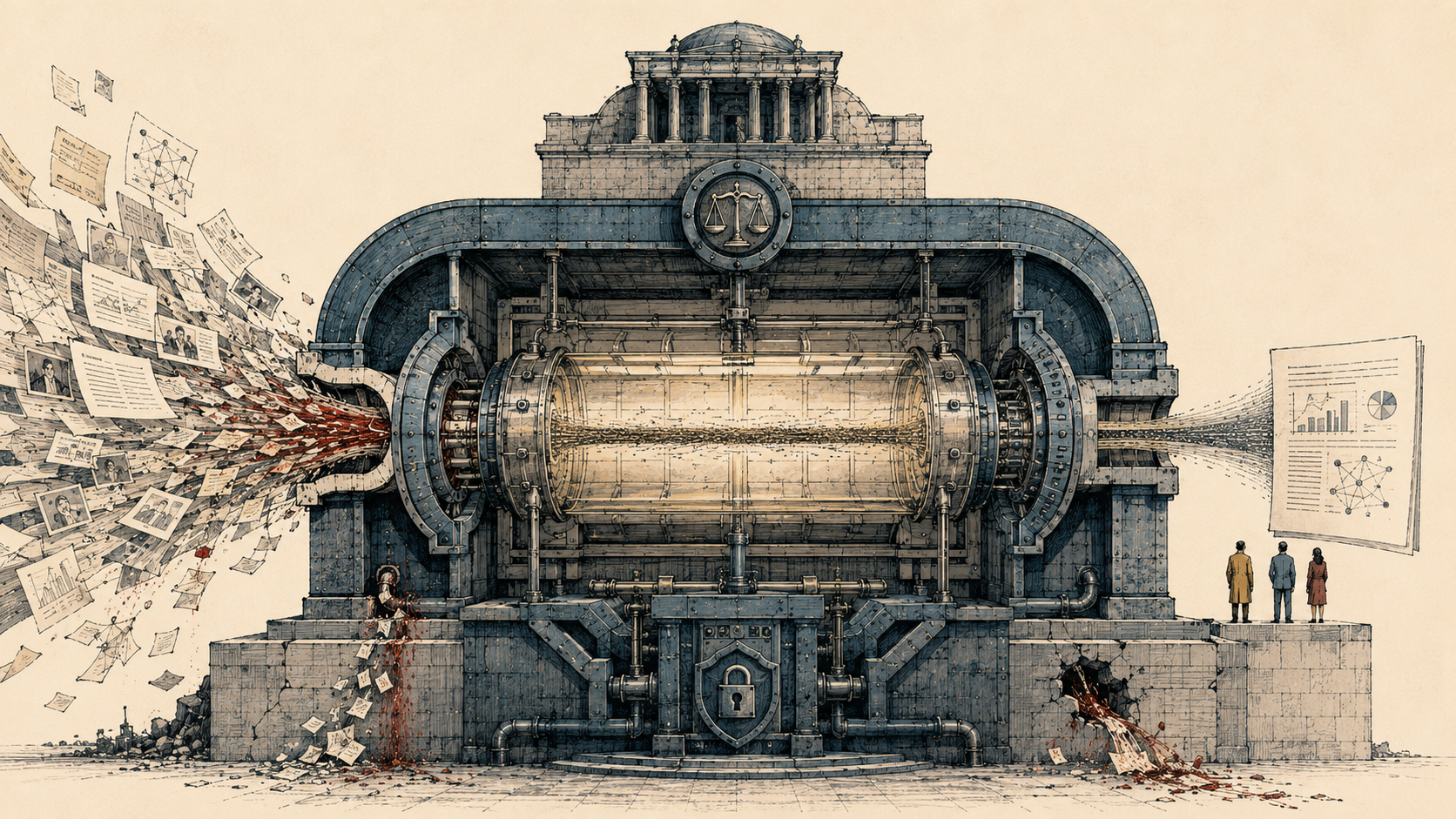
Enterprise trust has traditionally meant protecting data. Who can access the file? Where is the data stored? Is it encrypted? Is the system compliant? Are permissions enforced, activity audited, sensitive information controlled? These questions still matter — they are foundational — but in the age of AI-enabled work, they are no longer sufficient.
A system can protect the file and still allow the meaning of that file to be distorted, detached, overclaimed or misused. A strategy document can be secure and still be summarised incorrectly. A regulatory policy can be access-controlled and still lose a crucial caveat when translated for another audience. A meeting transcript can be safely stored and still fail to preserve the decision that mattered. An AI agent can have permission to read the right source and still act from the wrong interpretation. This is the missing layer of enterprise trust: meaning integrity.
Data security is not meaning security
Security answers one kind of question — is the data protected? Meaning integrity answers another — can the organisation trust what this now means? Those are different problems. A source can be authentic, but a later summary can be misleading. A document can be private, but a claim extracted from it can be unsupported. A deck can be approved, but the reasoning behind it can be lost. A policy can be accessible, but the version being used can be stale. A communication can be distributed, but the audience can misunderstand it.
Traditional enterprise systems are often good at protecting containers: files, folders, records, messages, databases and permissions. But organisations do not act on containers. They act on interpreted meaning — on what people believe a document says, what a summary implies, what a decision authorises, what a metric appears to prove, what a customer promise commits them to, what an AI agent treats as context. That is where the new risk lives.
The chain from source to action
Every important organisational action depends on a chain. A source is created, someone reads it, a claim is extracted, evidence is cited, a decision is made. A summary is written, a deck is produced, a message is distributed. Teams interpret it, work begins, AI systems reuse parts of it, and later decisions inherit it.
At each step, meaning can change. The source may be strong, but the claim may be weak. The claim may be accurate, but the evidence may disappear. The evidence may exist, but the summary may overstate it. The summary may be clear, but the audience may interpret it differently. The decision may be approved, but a later team may use an older version. The AI agent may retrieve a relevant passage, but fail to know whether it is current, disputed, superseded or safe to act on.
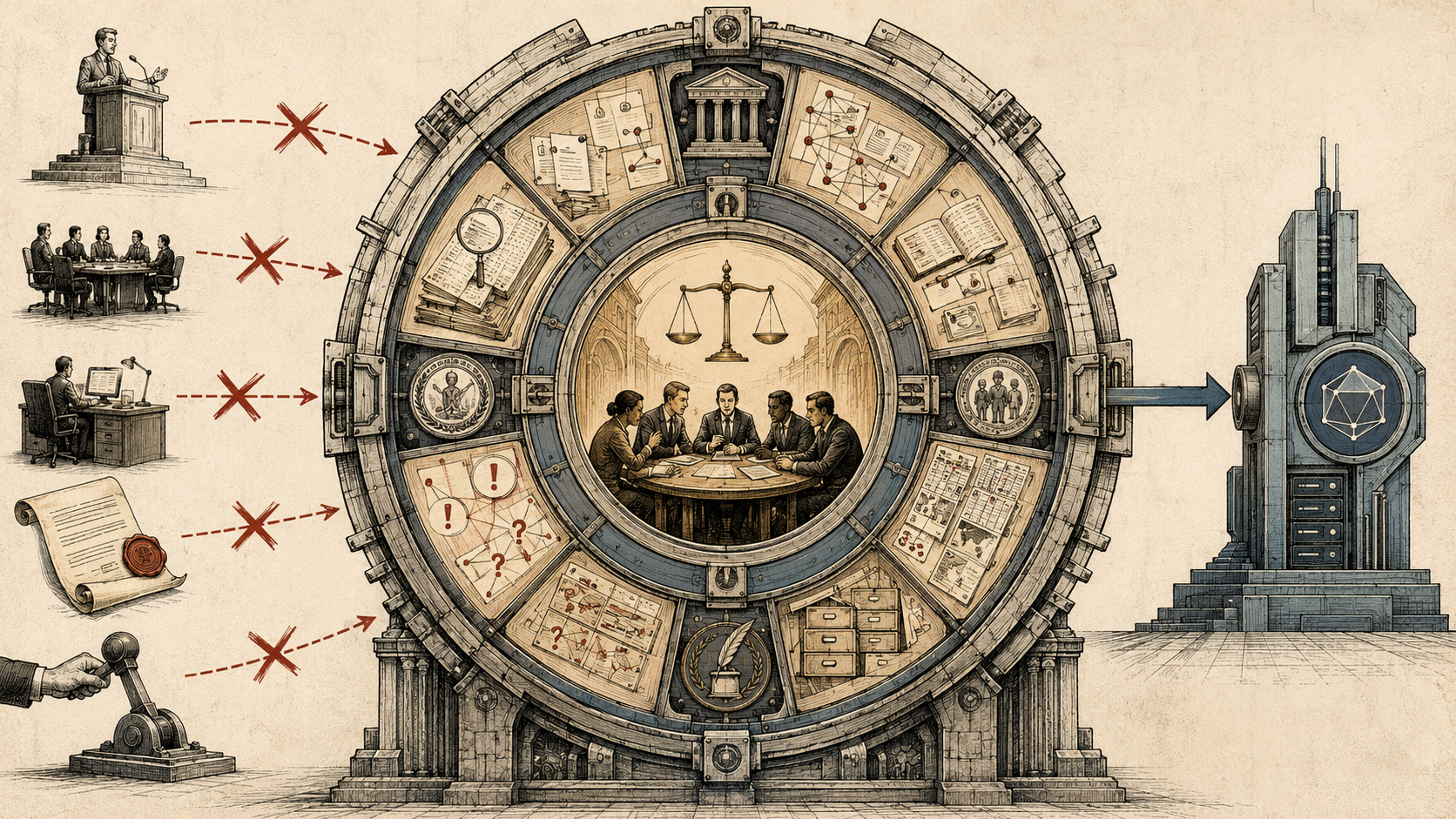
Meaning integrity is the discipline of preserving that chain. It asks whether the relationship between source, claim, evidence, decision, communication, interpretation and action remains intact.
Why AI increases the stakes
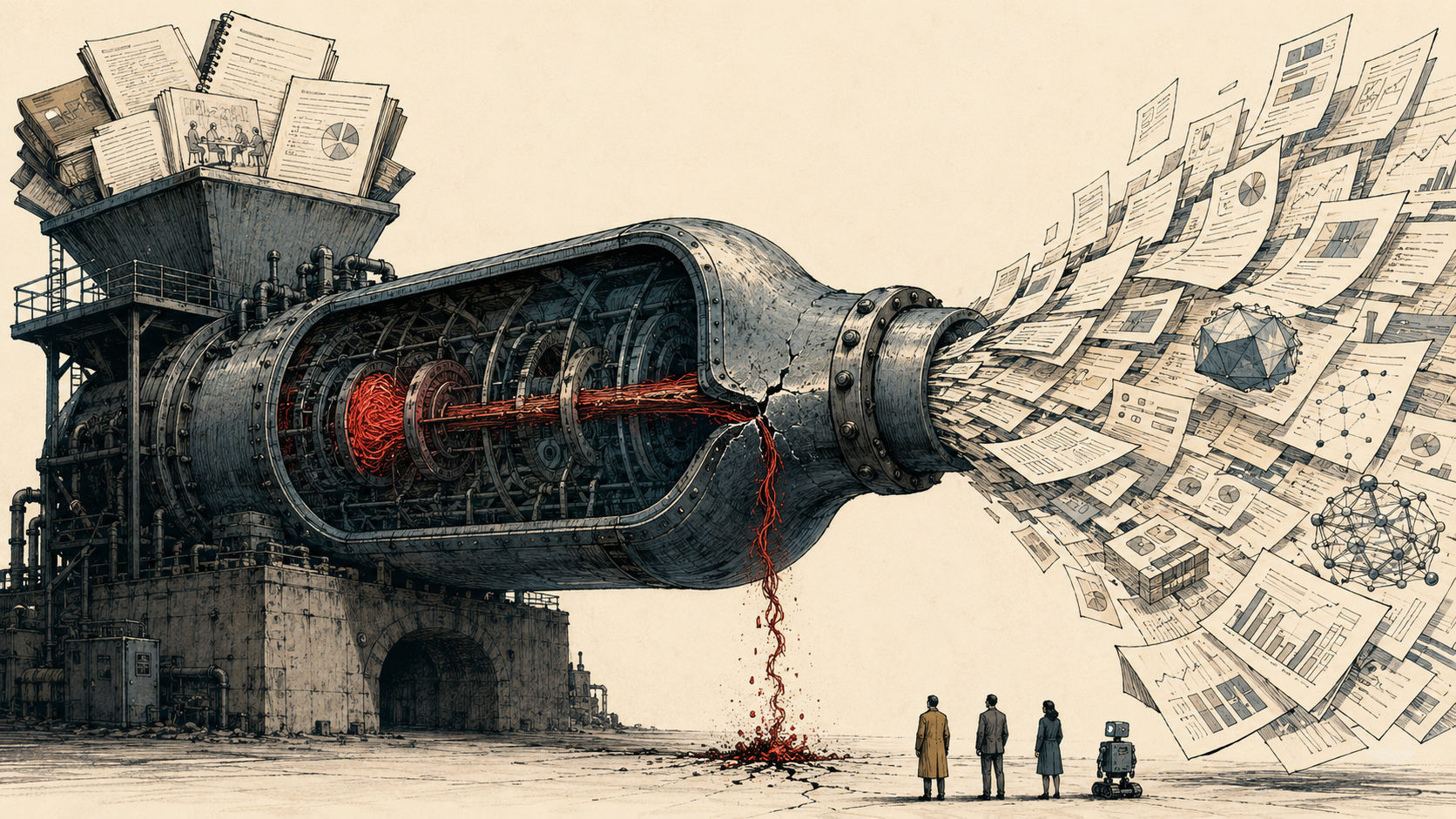
AI changes the trust problem because it changes the speed and scale of transformation. Before AI, a document might be rewritten a few times by a few people. Now, a source can be transformed into many outputs almost instantly: a summary, a briefing, a pitch deck, a customer email, an internal FAQ, an onboarding module, a strategy narrative, a task list, a leadership update and an agent instruction. Each transformation may be useful, and each may also introduce drift.
The danger is not merely that AI invents facts. The danger is that AI produces convincing organisational language whose relationship to the underlying source is unclear. It may remove uncertainty because uncertainty makes the answer less elegant. It may flatten contradiction because contradiction makes the output less readable. It may turn partial evidence into broad conclusion, treat a draft as a decision, treat a local team interpretation as the official company position, or make weak material sound strong. When this happens at scale, organisations get the appearance of coherence without the substance of it — confident outputs, but not necessarily trustworthy meaning.
The elements of meaning integrity
Meaning integrity is not a vague aspiration. It can be designed into systems, and a meaning-aware organisation needs to preserve several things at once.
Provenance
Where did this come from? Every claim, summary, recommendation and decision should remain connected to its source material. Provenance is the first defence against organisational drift because it makes origin visible.
Claim structure
What is being asserted? Many documents are full of hidden claims, and a meaning system should surface them, separate them and make them inspectable. This allows teams to distinguish between fact, interpretation, assumption, recommendation and decision.
Evidence
What supports the claim? Evidence should not be implied by polished language; it should be visible. A strong claim with weak evidence should not look the same as a strong claim with strong evidence.
Contradiction
What conflicts with this? Organisations often flatten contradiction in order to move quickly, but unresolved tension is valuable. It shows where judgment is required, where risk sits, and where communication needs care.
Version and authority
Which version matters now? A meaning system should distinguish draft, reviewed, approved, superseded and authoritative material, because agents and people need to know what can be acted on.
Confidence
How certain should we be? Confidence should be calibrated to evidence. A fluent answer should not be allowed to imply more certainty than the organisation has earned.
Comprehension
Did the meaning land? Distribution is not understanding. Open rates, views and attendance do not tell an organisation whether the audience understood the message, so meaning integrity has to include the receiving side of communication.
Action boundary
What can be done from this? This matters especially for AI agents: a system should know the difference between context for reading, context for drafting, context for recommendation, and context that authorises action.
Trust becomes measurable
The old model of communication often stopped at publish. The deck was sent, the memo shared, the policy distributed, the town hall held, the transcript stored, the summary posted — and then the organisation hoped meaning held. Meaning integrity turns that hope into a measurable system. It allows teams to ask:
- Which claims are unverified?
- Which sources support this recommendation?
- Which contradictions remain unresolved?
- Which teams interpreted the message differently?
- Which version is being used by which audience?
- Where did the argument become more confident than the evidence?
- What did the AI change when it transformed this material?
- What did people actually understand?
These are not cosmetic questions but operational ones. They determine whether organisations make decisions from grounded context or from the residue of communication drift.
Meaning integrity is a board-level issue
It is tempting to treat this as a knowledge management problem. It is bigger than that. Meaning integrity affects strategy, compliance, risk, customer communication, product development, onboarding, research, incident response, governance and AI adoption.
If a board-approved strategy mutates as it travels through the organisation, that is not a content problem — it is a control problem. If a compliance policy is simplified until the important constraint disappears, that is not a writing problem but a risk problem. If an AI agent acts from a superseded interpretation, that is not a model problem alone but an organisational context problem. And if teams believe they are aligned because everyone has seen the same deck, while each has understood a different version of it, that is not a communication problem but an execution problem. Meaning integrity is the missing bridge between trust, governance and action.
The next trust layer
Enterprises will continue to need data security, access control, compliance, audit logs and privacy-preserving architecture. But as AI becomes embedded into every workflow, those controls will need to be joined by another layer — one that preserves the integrity of meaning, keeping claims connected to sources, decisions connected to rationale, outputs connected to evidence, contradictions visible, confidence calibrated and comprehension measurable.
Security protects the data. Meaning integrity protects the decision. And in an AI-enabled organisation, that distinction will matter more every year.